62443 Fundamentals Specialist Study Guide
Condensed, original study notes for the ISA/IEC 62443 Cybersecurity Fundamentals Specialist exam (course IC32), with a matching practice exam in this repository. Not affiliated with or endorsed by ISA or IEC.
On this page
- Exam at a glance and a 7-day plan
- 1 · How an IACS differs from office IT
- 2 · Threats, attack paths and incidents
- 3 · The series, its roles and document types
- 4 · Core concepts: zones, conduits, security levels, requirements
- 5 · Lifecycles and maturity
- 6 · The security program: 2-1, 2-2 and 2-4
- 7 · Risk analysis basics
- 8 · Countermeasures and network security
- 9 · Operating securely
- 10 · Secure products, certification and regulation
- Exam traps, tie-breakers and sources
Exam at a glance and a 7-day plan
| Item | Detail |
|---|---|
| Certificate | ISA/IEC 62443 Cybersecurity Fundamentals Specialist |
| Course | IC32, Using the ISA/IEC 62443 Standards to Secure Your Control Systems (self-paced: IC32M) |
| Format | 90 multiple-choice questions, closed book |
| Time | 2 hours |
| Delivery | Meazure Learning test center, or online with live remote proctoring |
| Result | Pass or fail. ISA does not publish the passing score |
| What it unlocks | Prerequisite for Risk Assessment (IC33), Design (IC34) and Maintenance (IC37). All four certificates earn the ISA/IEC 62443 Cybersecurity Expert designation |
The Fundamentals exam is broad rather than deep. It checks that you know the vocabulary (zones, conduits, security levels, foundational requirements, maturity levels), which part of the series answers which question, how control systems differ from office IT, and the basics of risk, network security and secure operations. Many questions ask for the BEST or FIRST action, so learn the order of things (inventory before risk, assess before design, test before patching) as well as the definitions.
The practice app uses the same ten domains as this guide, one per section below. Its readiness meters show your accuracy per domain against an 80% target.
| Day | Read | Practice |
|---|---|---|
| 1 | IACS vs IT; threats and incidents | Quick 20 for a baseline, then domains 1–2 |
| 2 | The series and roles; core concepts | Domains 3–4 |
| 3 | Lifecycle and maturity; the security program | Domains 5–6 |
| 4 | Risk basics; countermeasures and networks | Domains 7–8 |
| 5 | Secure operations; products and certification | Domains 9–10 |
| 6 | Nothing new | Full 90-question mock under time, then review misses |
| 7 | Traps and tie-breakers; your two weakest domains | Second mock. Aim for 80% or better in every domain |
Original study notes, not ISA course material. Not affiliated with or endorsed by ISA or IEC. Check clause numbers against your licensed copies of the standards.
1 · How an IACS differs from office IT
An industrial automation and control system (IACS) is the people, hardware, software and policies that can affect the safe, secure and reliable operation of an industrial process. It includes DCS and SCADA systems, PLCs and RTUs, safety instrumented systems (SIS), HMIs, historians, engineering workstations and the networks that join them. Operational technology (OT) is the everyday name for the same territory. Note that the 62443 definition includes people and policies, not only technology.
| Concern | Office IT | IACS |
|---|---|---|
| First priority | Protecting data | Health, safety and environment (HSE), then keeping the process running |
| Usual ordering | Confidentiality, integrity, availability | Availability, integrity, confidentiality, with safety above all three |
| Worst outcome | Data breach, financial loss | Injury, environmental release, equipment damage, lost production |
| Service life | About 3–5 years | 15–20 years or more, so legacy operating systems are common |
| Uptime | Reboots and outages are routine | Runs around the clock; outages wait for planned shutdowns |
| Patching | Frequent and automated | Vendor-qualified, tested first, applied in maintenance windows |
| Performance | Throughput; short delays are tolerable | Deterministic and real time; delay or jitter can trip the process |
| Change | Fast, run by IT | Formal management of change (MOC) with a safety review |
| Protocols | Mostly authenticated and encrypted | Many legacy protocols (Modbus, classic DNP3) have neither |
| Endpoint tools | Agents everywhere | Limited CPU and memory; tools need vendor approval |
| People | IT staff | Operations and engineering, plus vendors and integrators on site |
Essential functions are the functions needed to maintain HSE, equipment integrity and availability: control, safety functions, and the operator's ability to see and steer the process. Losing them is described as loss of view or loss of control. A security measure must not adversely affect an essential function unless a risk assessment supports it. The classic example is account lockout on an operator HMI: locking out the console during an upset could stop an operator from acting, so the usual answer is to alarm on failed logins and use other compensating measures instead.
Why IT practice cannot simply be copied:
- Active scanning that is harmless on office PCs can crash fragile controllers. Prefer passive discovery and vendor-approved tools, and test on a non-production system first.
- Patching needs vendor compatibility testing and a window. When a patch cannot be applied, use compensating countermeasures such as segmentation and allowlisting.
- Antivirus and agents can consume resources or be unsupported. Application allowlisting suits fixed-function hosts well.
- Shared technology (Windows, Ethernet, TCP/IP) means IT threats such as ransomware reach OT. IT/OT convergence, remote access and cloud links increase the exposure.
Exam angle: when two answers are both secure, choose the one that keeps safety and availability intact. Never pick an option that disables a safety function or locks operators out of the process.
2 · Threats, attack paths and incidents
| Threat source | Usual motive | Example |
|---|---|---|
| Insider (employee or contractor) | Grievance, money, or plain error | Maroochy Shire, 2000 |
| Criminal group | Money through ransomware or extortion | Colonial Pipeline, 2021 |
| Nation-state | Espionage, sabotage, pressure | Stuxnet; Ukraine 2015 and 2016; Triton |
| Hacktivist | Publicity or protest | Tampering with internet-exposed PLCs and HMIs that keep default passwords |
| Untargeted malware | None; it spreads to whatever it can reach | Slammer at Davis-Besse, 2003; NotPetya, 2017 |
Common ways in: phishing and stolen credentials, remote access without multifactor authentication (MFA), vendor support tools, internet-exposed devices, removable media and visiting laptops, trojanized software updates (supply chain), unmanaged links that bypass the firewall, wireless and radio links, and insiders. Most serious IACS attacks begin in the business network and pivot into control.
Attack models
- Cyber Kill Chain (Lockheed Martin): reconnaissance, weaponization, delivery, exploitation, installation, command and control, actions on objectives. Breaking any link stops the attack, and detecting early links costs less than recovering from the last one.
- ICS Cyber Kill Chain (SANS, 2015): stage 1 is a conventional intrusion to gain access and learn about the control system. Stage 2 is developing, testing and delivering the attack on the process. Stage 2 needs time and process knowledge, which gives defenders a window to detect.
- MITRE ATT&CK for ICS: a public knowledge base of adversary tactics and techniques. Three of its tactics are specific to control systems: Inhibit Response Function, Impair Process Control and Impact.
| Year | Incident | What happened | Lesson |
|---|---|---|---|
| 2000 | Maroochy Shire, Australia | A former contractor employee used radio gear to command sewage pumping stations; raw sewage spilled into parks and waterways | Insider threat; unauthenticated radio links; revoke access when people leave |
| 2003 | Slammer worm, Davis-Besse nuclear plant, US | The worm came in through a contractor link that bypassed the firewall and disabled a safety display system for about five hours while the plant was offline | Untargeted malware; uncontrolled connections; patching |
| 2010 | Stuxnet, Natanz, Iran | Spread by USB and Windows zero-days, reprogrammed PLCs driving centrifuges, and replayed normal values to the operators | An air gap is not a control; removable media; integrity of control logic |
| 2015 | Ukraine distribution grid | Phishing, stolen credentials and VPN access let attackers open breakers from the operators' own HMIs; about 225,000 customers lost power for hours; hosts were wiped and serial-to-Ethernet gateways bricked with bad firmware | MFA on remote access; segmentation; firmware integrity; manual fallback |
| 2016 | Industroyer (CrashOverride), Kyiv transmission substation | Malware spoke grid protocols (IEC 60870-5-101 and -104, IEC 61850, OPC DA) directly to switching equipment | Attackers automate with native industrial protocols; monitor OT traffic |
| 2017 | Triton (Trisis), petrochemical plant, Saudi Arabia | Attackers tried to reprogram safety controllers; a fault tripped the plant to a safe state and exposed them | Safety systems are targets; keep the SIS separate; keep controllers in run mode |
| 2017 | NotPetya | A wiper spread through a hijacked accounting-software update and Windows exploits, halting global manufacturers and shippers | Supply chain risk; segmentation; offline backups |
| 2021 | Colonial Pipeline, US | Ransomware entered IT through a VPN account without MFA; the company shut down pipeline operations for several days as a precaution | IT incidents stop OT; MFA; know OT's dependencies on IT |
Exam angle: know which incident illustrates which lesson, and remember that an "isolated" network was the starting assumption in several of them.
3 · The series, its roles and document types
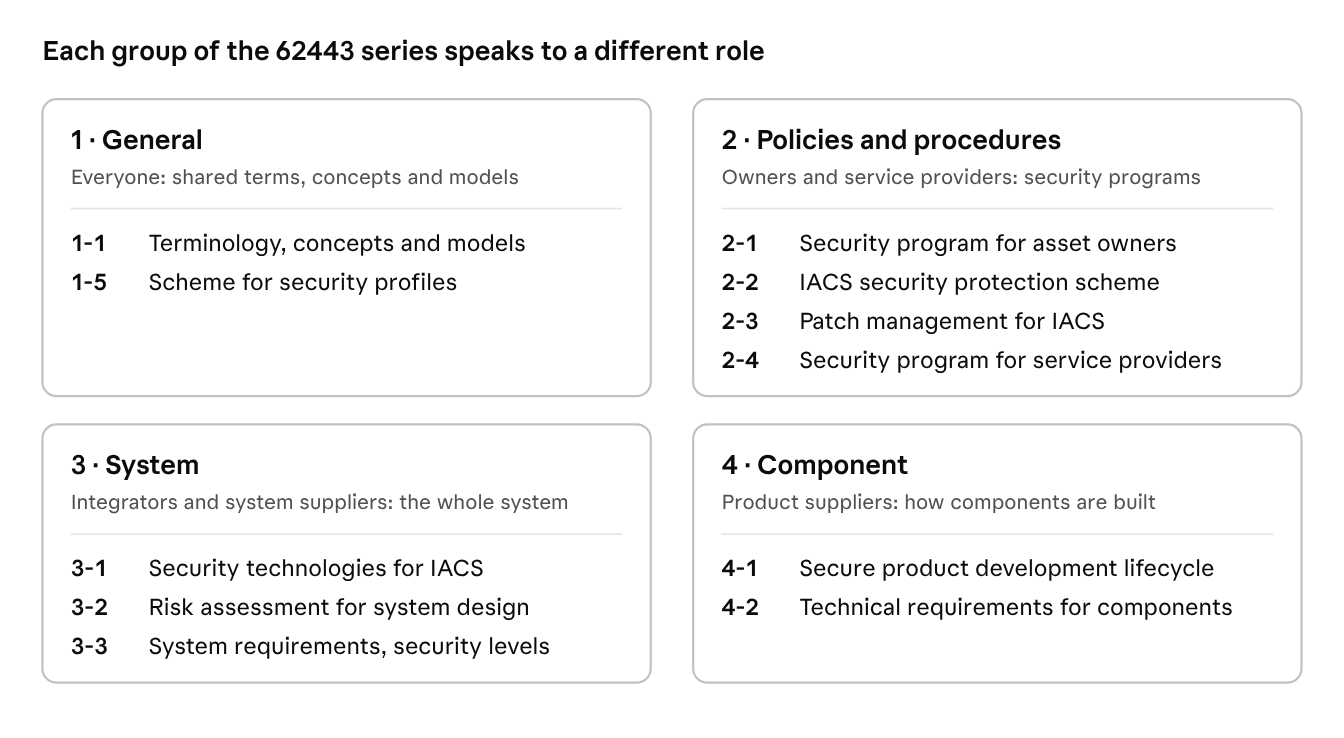
The series is developed by the ISA99 committee and published by both ISA (as ISA-62443) and IEC (as IEC 62443, through technical committee TC 65), which is why it is called ISA/IEC 62443. In 2021 IEC designated it a horizontal standard, meaning it applies across industry sectors rather than to one. Its four groups move from shared concepts (1-x), to the programs of the organizations that run and support an IACS (2-x), to requirements for the whole system (3-x), to requirements for single components and how they are developed (4-x).
| Part | What it gives you | Main user |
|---|---|---|
| 1-1 | Terminology, concepts and models, such as zones, conduits and the reference model (TS, 2009) | Everyone |
| 1-5 | Scheme for security profiles: how to select 62443 requirements for a sector or use case and map them to that context, without adding or changing requirements (TS, 2023) | Sector groups, suppliers, assessors |
| 2-1 | Security program requirements for asset owners: eight security program elements and a maturity model (edition 2, 2024). Edition 1 (2010) was Establishing an IACS security program, the CSMS | Asset owners |
| 2-2 | IACS security protection scheme: the technical, physical and process measures that protect an IACS in operation, rated with security protection ratings (IEC PAS and ISA technical report, 2025) | Asset owners with their service providers |
| 2-3 | Patch management in the IACS environment (TR, 2015) | Asset owners and product suppliers |
| 2-4 | Security program requirements for integration and maintenance service providers, SP.01–SP.12 (edition 2, 2023) | Integrators and maintenance providers |
| 3-1 | Security technologies for IACS: a survey of controls and their limits (TR, 2009) | Anyone choosing countermeasures |
| 3-2 | Security risk assessment for system design: zones and conduits, target security levels, the cybersecurity requirements specification (2020) | Asset owners and integrators |
| 3-3 | System security requirements and security levels: seven foundational requirements broken into system requirements and enhancements (2013) | Integrators and system suppliers |
| 4-1 | Secure product development lifecycle requirements: eight practices (2018) | Product suppliers |
| 4-2 | Technical security requirements for IACS components, by component type (2019) | Product suppliers |
Document types. An International Standard holds normative requirements you can be assessed against. A Technical Specification (TS) or Publicly Available Specification (PAS) is also normative but published before full consensus. A Technical Report (TR) is informative guidance with no requirements.
Principal roles
- Asset owner: accountable for the IACS and its security in operation; often called the operator.
- Integration service provider: designs, installs and commissions the automation solution (the system integrator).
- Maintenance service provider: supports and maintains the automation solution once it runs.
- Product supplier: develops and supports the components and systems the solution is built from.
One organization can play several roles: an asset owner with its own engineers is also its own integrator and maintainer. The automation solution is the control system as delivered (hardware, software and configuration). The IACS adds the people, policies and procedures of the asset owner who runs it.
| Question | Part |
|---|---|
| How do we run security across our sites? | 2-1 |
| How do we protect and rate an IACS in operation? | 2-2 |
| How should we handle patches? | 2-3 |
| What must our integrator or maintenance contractor do? | 2-4 |
| How do we split the system into zones and set targets? | 3-2 |
| What must the system be able to do for a given security level? | 3-3 |
| How must the vendor develop its products? | 4-1 |
| What must a PLC, switch, server or HMI application be able to do? | 4-2 |
Exam angle: "which part" questions are common. Tie the role to the group: owner to 2-1, service provider to 2-4, system design to 3-2 and 3-3, product supplier to 4-1 and 4-2.
4 · Core concepts: zones, conduits, security levels, requirements
Defense in depth stacks independent layers so that one failure does not expose the process: policies and awareness, physical security, network segmentation, host hardening, application and device security, then monitoring and response.
- Zone: a group of logical or physical assets that share common security requirements, with a defined border. Typical groupings follow criticality, function, location or ownership. The safety instrumented system normally gets a zone of its own.
- Conduit: a logical group of communication channels that connect two or more zones and share common security requirements. All traffic between zones should cross a conduit, which is where boundary controls such as firewalls sit.
- Least privilege and least functionality: give users, devices and programs only the rights, ports and services they need.
- Compensating countermeasure: an alternative measure used when a requirement cannot be met directly, such as putting a legacy controller that cannot authenticate users behind a tightly filtered zone boundary.
| Level | Reference-model name | Examples |
|---|---|---|
| 4 | Enterprise business systems | ERP, email, business planning |
| 3 | Operations management | MES, historian, scheduling, site servers |
| 2 | Supervisory control | HMIs, SCADA servers, engineering workstations |
| 1 | Basic control, plus safety and protection | PLCs, DCS controllers, RTUs, safety controllers |
| 0 | Process | Sensors, actuators, drives |
A DMZ between levels 3 and 4 (sometimes called level 3.5) is a zone of shared services, such as a historian replica, patch server or jump host. No traffic should pass straight through it between the business and control networks.
Security levels (SL) describe the strength of attacker a zone, conduit, system or component can withstand.
| SL | Protects against | Means | Resources | Skills | Motivation |
|---|---|---|---|---|---|
| 0 | No specific requirement or protection | – | – | – | – |
| 1 | Casual or coincidental violation | – | – | – | – |
| 2 | Intentional violation | Simple | Low | Generic | Low |
| 3 | Intentional violation | Sophisticated | Moderate | IACS-specific | Moderate |
| 4 | Intentional violation | Sophisticated | Extended | IACS-specific | High |
- SL-T (target): the level a zone or conduit needs, set by the risk assessment (3-2).
- SL-C (capability): the level a component or system can reach when properly configured (3-3, 4-2).
- SL-A (achieved): the level the zone actually reaches as built and operated, checked after implementation.
- Pick components whose SL-C meets the SL-T, or add compensating countermeasures, then confirm the SL-A.
The seven foundational requirements (FR) organize every technical requirement in 3-3 and 4-2.
| FR | Name | Short | Covers |
|---|---|---|---|
| 1 | Identification and authentication control | IAC | Identify and authenticate every user: people, software processes and devices |
| 2 | Use control | UC | Enforce what an authenticated user may do: authorization, session lock, mobile code, portable devices |
| 3 | System integrity | SI | Prevent unauthorized changes to software and data; malware protection; integrity checks |
| 4 | Data confidentiality | DC | Protect information in transit and at rest; purge data from retired media |
| 5 | Restricted data flow | RDF | Segment the network and limit flows between zones |
| 6 | Timely response to events | TRE | Audit logs, monitoring, and reporting of violations |
| 7 | Resource availability | RA | Withstand denial of service; backup and recovery; least functionality |
Because a level is set per FR, an SL is a vector of seven values written in FR order, for example SL-T = {2 2 2 1 3 1 2}. In 3-3 each FR breaks down into system requirements (SRs, such as SR 1.1) with requirement enhancements (REs) that add strength at higher levels. 4-2 mirrors them as component requirements (CRs), plus requirements specific to software applications, embedded devices, host devices and network devices.
Security is not safety. Functional safety (IEC 61508 and IEC 61511) guards against random and systematic failures and uses safety integrity levels (SIL). Security guards against deliberate attack and uses security levels. A SIL does not map to an SL.
Exam angle: SL-T belongs to zones and conduits, SL-C to products and systems, SL-A to what was built. An SL is a vector across the seven FRs, not one number.
5 · Lifecycles and maturity
Keep three lifecycles apart, because each belongs to a different role:
| Lifecycle | Owner | Parts | Covers |
|---|---|---|---|
| Product development | Product supplier | 4-1, 4-2 | Requirements, design, implementation, verification, release, security updates, end of support |
| Automation solution | Integration and maintenance service providers | 2-4, 3-2, 3-3 | Design, integration, testing, commissioning, handover, then ongoing support |
| IACS in operation | Asset owner | 2-1, 2-2, 2-3 | Operation, maintenance, change, incident response, decommissioning |
The ISA certificate courses follow the IACS through three phases, each matching one of the later certificates:
- Identification and assessment (Risk Assessment, IC33): define the system under consideration, run a high-level risk assessment, partition it into zones and conduits, run detailed risk assessments, set target security levels, and record the requirements in a cybersecurity requirements specification (CRS).
- Design and implementation (Design, IC34): design countermeasures that meet the CRS, select products, build, test at the factory and on site, commission and hand over.
- Operations and maintenance (Maintenance, IC37): monitor, patch, back up, respond to incidents, manage change, audit, and finally decommission.
The lifecycle is a loop. Changes, new threats and vulnerabilities, incidents and audit findings all send you back to reassess. Decommissioning is a security step too: revoke accounts and remote access, sanitize or destroy storage media, and update the asset inventory and drawings.
Security is cheapest when built in early. Adding it after commissioning usually means outages, rework and compensating countermeasures.
Maturity levels measure how well an organization performs a process, not how strong a product is. 4-1 and 2-4 use four levels, adapted from CMMI; 2-1 (2024 edition) also defines a maturity model for asset owners.
| ML | Name | What it looks like |
|---|---|---|
| 1 | Initial | Ad hoc and often undocumented; results depend on individuals |
| 2 | Managed | Written policies and procedures; trained staff who can perform them, though there may be little evidence yet |
| 3 | Defined (Practiced) | The documented process is followed consistently, with evidence |
| 4 | Improving | The process is measured and continuously improved |
| Measure | Rates | Example |
|---|---|---|
| Security level (SL) | Technical capability: what a zone, system or component can withstand | A controller with SL-C 2 for FR 1 |
| Maturity level (ML) | Process: how consistently an organization does what it says | A service provider at ML 3 for patch management |
Both matter: a capable product run by an immature process still fails. 2-2 brings the two together when it rates the protection of an IACS in operation.
Exam angle: "evidence that the documented process is followed" points to ML 3. "Ad hoc" points to ML 1. A question about a product's strength is about SL; a question about an organization's consistency is about ML.
6 · The security program: 2-1, 2-2 and 2-4
Security is a management process that never ends, not a project. Every program, whatever standard it follows, needs the same building blocks:
- Management commitment and a business rationale: why security matters here, in terms of HSE, production, reputation and regulation. This comes first, because it secures the budget and authority.
- Scope and organization: which sites and systems, who owns OT security, and how IT, operations, engineering, safety, procurement and HR work together.
- Policies, procedures, training and awareness: role-based training for staff and contractors. Awareness is a countermeasure in its own right, since many attacks start with a person.
- Risk assessment and treatment, then countermeasures and implementation.
- Monitoring, audit and continuous improvement (plan, do, check, act).
2-1 edition 1 (2010) called this a cybersecurity management system (CSMS) and grouped it into three categories:
| Category | Elements |
|---|---|
| Risk analysis | Business rationale; risk identification, classification and assessment |
| Addressing risk with the CSMS | Policy, organization and awareness: CSMS scope, organizing for security, staff training and awareness, business continuity plan, security policies and procedures. Selected countermeasures: personnel security, physical and environmental security, network segmentation, and access control (account administration, authentication, authorization). Implementation: risk management and implementation, system development and maintenance, information and document management, incident planning and response |
| Monitoring and improving the CSMS | Conformance; review, improve and maintain the CSMS |
2-1 edition 2 (2024) speaks of an IACS security program instead. It regroups the requirements into eight security program elements (SPEs), removes overlap with an information security management system (ISMS) such as ISO/IEC 27001 by building on it rather than repeating it, and adds a maturity model for rating each requirement.
| SPE | Name | Sub-elements |
|---|---|---|
| 1 | Organizational security measures (ORG) | Security organization and policies; security assessments and reviews; physical access |
| 2 | Configuration management (CM) | Inventory of IACS hardware, software and network communications |
| 3 | Network and communications security (NET) | System segmentation; secure wireless access; secure remote access |
| 4 | Component security (COMP) | Components and portable media; malware protection; patch management |
| 5 | Protection of data (DATA) | Protection of data |
| 6 | User access control (USER) | Identification and authentication; authorization and access control |
| 7 | Event and incident management (EVENT) | Event and incident management |
| 8 | System integrity and availability (AVAIL) | System availability and intended functionality; backup, restore and archive |
2-2 (2025) describes the security protection scheme for an IACS in operation: the technical, physical and process measures that address its cybersecurity risks. It rates protection with security protection ratings in target, implemented and operated forms, and it covers the asset owner, integration and maintenance service providers and product suppliers across the lifecycle, including periodic revalidation in operation.
2-4 (edition 2, 2023) sets the security capabilities that integration and maintenance service providers must be able to offer asset owners. Its requirements fall into twelve functional areas, and capability in each is rated with maturity levels.
| Area | Topic | Area | Topic |
|---|---|---|---|
| SP.01 | Solution staffing | SP.07 | Remote access |
| SP.02 | Assurance | SP.08 | Event management |
| SP.03 | Architecture | SP.09 | Account management |
| SP.04 | Wireless | SP.10 | Malware protection |
| SP.05 | Safety instrumented system (SIS) | SP.11 | Patch management |
| SP.06 | Configuration management | SP.12 | Backup and restore |
Asset owners often pick 2-4 requirements for their contracts, so a provider's capability becomes a purchasing condition.
Exam angle: the first step in building a program is management commitment backed by a business rationale. Personnel security includes removing access promptly when people leave, the lesson of Maroochy. 2-1 is the owner's program; 2-4 is the provider's.
7 · Risk analysis basics
Risk combines the likelihood that a threat exploits a vulnerability with the consequence if it does.
| Term | Meaning |
|---|---|
| Threat | An actor or circumstance with the potential to cause harm |
| Vulnerability | A weakness a threat can exploit: a flaw, misconfiguration, missing control or procedural gap |
| Consequence | The outcome: HSE, production, equipment, financial, reputational, regulatory |
| Likelihood | How probable the event is. For cyber events it is hard to base on statistics, so it is usually judged from threat capability and motivation, exposure and the vulnerability |
| Countermeasure | An action, device, procedure or technique that reduces risk |
| Unmitigated risk | Risk before countermeasures are counted (also called inherent risk) |
| Residual risk | Risk that remains after countermeasures |
| Tolerable risk | The level the organization accepts, set by its risk criteria, often drawn as a risk matrix |
Ways to measure it
- Qualitative: high, medium, low on a likelihood × consequence matrix. The most common in OT.
- Semi-quantitative: scores on scales, multiplied or added.
- Quantitative: money and frequencies, for example annualized loss expectancy (ALE) = single loss expectancy (SLE) × annualized rate of occurrence (ARO).
Treating risk: reduce it with countermeasures, avoid it by removing the activity (for example an unneeded connection), transfer or share it through insurance or contracts, or accept it formally. Risk is never zero; the aim is residual risk at or below the tolerable level, accepted by someone with the authority to do so, normally asset-owner management.
How 62443-3-2 applies risk to system design (the subject of the Risk Assessment certificate):
- Identify the system under consideration (ZCR 1).
- Run an initial, high-level risk assessment of worst-case consequences, assuming the attack succeeds (ZCR 2).
- Partition the system into zones and conduits (ZCR 3).
- Compare the initial risk with tolerable risk; if it is higher, continue (ZCR 4).
- Run a detailed risk assessment for each zone and conduit: threats, vulnerabilities, consequences, likelihood, target security level, countermeasures and residual risk (ZCR 5).
- Document the cybersecurity requirements, assumptions and constraints in the CRS (ZCR 6).
- Obtain asset-owner approval (ZCR 7).
Inputs include the asset inventory, network and data-flow diagrams, process hazard analysis (PHA or HAZOP) results, known vulnerabilities, threat intelligence, existing countermeasures and policies. The PHA tells you the worst credible consequence of losing or misusing a control function. A cyber PHA treats a cyberattack as one more cause of process deviations and asks whether the same attack could also defeat the safeguards. IEC 61511 requires a security risk assessment for safety instrumented systems.
| Activity | Purpose |
|---|---|
| Gap assessment | Compare current practice with a standard or policy |
| Vulnerability assessment | Find weaknesses through documents, interviews, configuration review, passive monitoring, and scanning where safe |
| Penetration test | Exploit weaknesses to prove impact; in OT, only on test or offline systems, with approval |
| Risk assessment | Combine threats, vulnerabilities and consequences to rank and treat risk |
Exam angle: risk is reduced to a tolerable level, never eliminated. Asset-owner management accepts residual risk. Likelihood is the hardest part to estimate in cybersecurity, which is why consequence-driven methods are common in OT.
8 · Countermeasures and network security
62443-3-1 surveys the toolbox in six families: authentication and authorization; filtering, blocking and access control; encryption and data validation; management, audit, measurement, monitoring and detection; computer software; and physical security. No single tool is enough, so layer them.
Firewalls
| Type | Looks at | Use and limits |
|---|---|---|
| Packet filter (stateless) | Addresses, ports and protocol of each packet | Fast and simple; no idea of sessions |
| Stateful inspection | The same, plus connection state | Lets return traffic back only for sessions that started legitimately |
| Application-layer, deep packet inspection | Protocol content, such as Modbus function codes | Can allow reads but block writes; common in industrial firewalls |
| Unidirectional gateway (data diode) | Physics: hardware allows one direction only | Pushes data out of control, such as a historian replica, with no path back in |
Good rule sets deny by default and permit by exception; name specific sources, destinations and ports (never "any to any"); record a business reason for each rule; filter outbound traffic as well as inbound; log denied traffic; and are reviewed regularly.
Segmentation
- Separate business and control networks with a DMZ and firewalls. Connections end in the DMZ: business users read the historian replica there, never the controllers.
- VLANs separate traffic at layer 2 but are not a security boundary on their own. Pair them with firewalls or access control lists.
- Avoid dual-homed hosts (one computer on two networks), which bridge zones around the firewall.
- Give the safety instrumented system, wireless networks and remote access their own zones.
Remote access: route it through a jump host in the DMZ with multifactor authentication, named accounts, approved and time-limited sessions, and session monitoring or recording. Do not let a VPN land directly on level 1 or 2, and disable vendor access when it is not in use. A VPN protects data in transit, but the remote laptop at the other end becomes part of your network.
Hosts and devices: remove or disable unused services, ports, accounts and software; change default passwords; follow the vendor's hardening guide; control USB ports and removable media; enable logging. Antivirus needs signature updates and vendor approval, and scans can load old hardware. Application allowlisting lets only approved programs run, which suits OT hosts whose software rarely changes.
Access control: unique named accounts, role-based access control, least privilege, separation of duties, MFA for remote and privileged access, regular account reviews and prompt removal at termination. Physical security still matters: locked cabinets, controlled rooms, port blockers, and controller key switches kept in run mode.
Monitoring: a network intrusion detection system (IDS) listening passively on a SPAN port or tap suits OT. An inline intrusion prevention system (IPS) can block legitimate control traffic, so use it with care.
| Protocol | Default port | Built-in security |
|---|---|---|
| Modbus/TCP | TCP 502 | None: any client can write registers and coils. A TLS variant exists (TCP 802) |
| DNP3 | TCP/UDP 20000 | Optional Secure Authentication |
| EtherNet/IP (CIP) | TCP 44818, UDP 2222 | Optional CIP Security |
| OPC Classic (DA) | TCP 135 plus dynamic ports (DCOM) | Weak; hard to firewall |
| OPC UA | TCP 4840 | Certificates, signing and encryption when enabled |
| IEC 60870-5-104 | TCP 2404 | None; IEC 62351 adds it |
| IEC 61850 MMS | TCP 102 | IEC 62351 adds it; GOOSE runs as layer 2 multicast |
| BACnet/IP | UDP 47808 | Optional BACnet Secure Connect |
Wireless: put it in its own zone, use enterprise-grade encryption and authentication, and remember that radio can be jammed, so avoid it for functions that cannot tolerate loss.
Exam angle: deny by default; a VLAN is not a firewall; traffic ends in the DMZ; a data diode for one-way export; allowlisting for fixed-function hosts; passive monitoring before active scanning.
9 · Operating securely
Start with the asset inventory. You cannot protect, patch or recover what you do not know about. Record hardware, software and firmware versions, network connections, owners and criticality, and keep the record current through management of change.
Patch management (62443-2-3)
- The product supplier tests patches for compatibility with its products and tells customers which are approved. The asset owner decides, tests, deploys and records. Service providers often help.
- Asset-owner process: keep the inventory; monitor vendor notices and advisories; judge applicability and urgency by risk; test on a non-production system; back up; deploy in a maintenance window, in stages; verify; update records.
- When a patch cannot be applied (no vendor approval, no outage window, or an unsupported product), use compensating countermeasures such as segmentation, allowlisting, disabling the vulnerable service and closer monitoring, and plan a migration.
- 2-3 also proposes a common file format in which suppliers report which patches they have tested with their products.
Backup and restore: back up controller logic, configurations, HMI and engineering projects, firmware, system images and historian data. Keep at least one copy offline and off site (the 3-2-1 rule: three copies, on two kinds of media, one off site), protect backups from tampering, and test restores regularly. A backup that has never been restored is a hope, not a control.
Incident response is planned before it is needed. The team includes operations, engineering, IT, safety, legal, communications and key vendors. NIST SP 800-61 Rev. 2 describes four phases: preparation; detection and analysis; containment, eradication and recovery; and post-incident activity, where lessons learned improve the program. (Rev. 3, 2025, reorganizes this guidance around the CSF 2.0 functions.) In OT, safety comes first: containment may mean isolating zones or switching to manual operation. Preserve evidence where you safely can, and meet any reporting duties.
Business continuity and disaster recovery: a business continuity plan keeps essential operations going, for example with manual procedures, spare parts and alternate sites. A disaster recovery plan restores the systems. Exercise both, for example with tabletop drills.
Management of change (MOC): every change to hardware, software, firmware, configuration, network, firewall rules or accounts is requested, assessed for safety and security impact, approved, tested, implemented and documented, with drawings, inventory and backups updated. Emergency changes are documented and reviewed afterward.
Monitoring and logging: collect security events, logins and configuration changes; synchronize clocks so events line up; centralize logs in a SIEM; review and alert; and keep them for as long as policy requires.
Account management: a joiner, mover and leaver process; periodic reviews of accounts and privileges; no default or unused accounts; controlled emergency (break-glass) accounts.
Removable media and visiting laptops: scan them at a kiosk before use, allow only approved devices, and log their use.
Audits: periodic audits check that policies are followed and controls work. Reassess risk after significant changes or incidents.
Decommissioning: sanitize or destroy storage media (NIST SP 800-88: clear, purge or destroy), then remove accounts, remote access and records.
Exam angle: inventory before patching, back up before changing, test before deploying, safety first in an incident, and every change goes through MOC, security changes included.
10 · Secure products, certification and regulation
62443-4-1: the eight practices of secure product development
| # | Practice | Short | Examples |
|---|---|---|---|
| 1 | Security management | SM | Defined process and roles, security expertise, secure development environment, control of private keys, third-party components |
| 2 | Specification of security requirements | SR | Product security context, threat model, security requirements and their review |
| 3 | Secure by design | SD | Secure design principles, defense in depth, design reviews |
| 4 | Secure implementation | SI | Secure coding standards, implementation reviews |
| 5 | Security verification and validation testing | SVV | Requirements and threat-mitigation testing, vulnerability testing, penetration testing, independent testers |
| 6 | Management of security-related issues | DM | Receive, assess, fix and disclose reported vulnerabilities |
| 7 | Security update management | SUM | Qualify, document and deliver updates promptly |
| 8 | Security guidelines | SG | Defense-in-depth and hardening guidance, secure operation, account management and disposal |
62443-4-2: what a component must be able to do
- Four component types: software application (SAR), such as an HMI or historian application; embedded device (EDR), such as a PLC, IED or smart sensor; host device (HDR), such as a workstation or server; network device (NDR), such as a switch, router, firewall or wireless access point.
- Component requirements (CRs) mirror the 3-3 SRs, plus requirements specific to a type, such as protecting physical diagnostic and test interfaces on devices.
- Common component security constraints (CCSC): 1, support of essential functions; 2, compensating countermeasures; 3, least privilege; 4, development and support under a 4-1 process.
- A component's SL-C is stated per FR. A system's capability depends on its components and how they are put together.
The supplier's security guidelines describe the environment and defenses the product expects and how to harden and configure it. A product used outside those assumptions may not deliver its stated capability.
Certification
| Program | Certifies | Against |
|---|---|---|
| ISASecure SDLA | A supplier's development lifecycle process | 4-1 |
| ISASecure CSA | A component (successor of the older EDSA) | 4-2, with 4-1 development |
| ISASecure SSA | A control system | 3-3, with 4-1 development |
| IECEE CB Scheme | Products and capabilities, through accredited bodies | Several parts of the series |
ISASecure is run by the ISA Security Compliance Institute (ISCI). A certified component still has to be deployed securely: certification proves capability, not the security of your plant.
Security profiles (1-5) select 62443 requirements for a sector, application or product type and explain how each applies in that context. A profile may not add requirements or modify existing ones, it states the security level and maturity level that apply, and it is supported by a risk evaluation. Profiles make assessments comparable across a sector.
Related frameworks and regulations
| Framework | Applies to | Key point |
|---|---|---|
| NIST Cybersecurity Framework 2.0 (2024) | Any organization | Six functions: Govern, Identify, Protect, Detect, Respond, Recover |
| NIST SP 800-82 Rev. 3 (2023) | OT operators | US guide to OT security; draws on 62443 |
| NERC CIP | Bulk electric system in North America | Mandatory and enforceable |
| EU NIS2 Directive | Essential and important entities in the EU | National laws were due by October 2024 |
| EU Cyber Resilience Act | Products with digital elements sold in the EU | Reporting duties apply from September 2026; most obligations from December 2027 |
| IEC 61511 and ISA-TR84.00.09 | Safety instrumented systems | Security risk assessment of the SIS |
| ISO/IEC 27001 | Information security management systems | 2-1 (2024) builds on an ISMS |
Exam angle: SDLA certifies the process, CSA the component, SSA the system. CCSC 4 ties 4-2 to 4-1. Profiles select and map requirements but never invent them.
Exam traps, tie-breakers and sources
Pairs that get mixed up
| Easily confused | The difference |
|---|---|
| SL, SIL, ML | Security strength per FR; functional safety integrity; process maturity |
| SL-T, SL-C, SL-A | Needed by a zone or conduit; offered by a product or system; reached as built |
| Zone, conduit | A group of assets; a group of communication channels between zones |
| 2-1, 2-4, 4-1 | The owner's program; the service provider's program; the supplier's development process |
| 2010 CSMS, 2024 SPEs | Three categories of CSMS elements; eight security program elements with a maturity model |
| Standard, TR | Requirements you can be assessed against; guidance only (2-3 and 3-1 are TRs) |
| SDLA, CSA, SSA | Certifies the process; the component; the system |
| VLAN, firewall | Separates traffic; enforces a security policy |
First steps the exam likes to ask about
- Building a program: management commitment and a business rationale.
- Patching or risk work: an up-to-date asset inventory.
- A 3-2 risk assessment: identify the system under consideration.
- An OT incident: keep people and the process safe, then contain.
- A change: put it through MOC, even when it is a security fix.
Tie-breakers for BEST answers
- Keep safety and availability intact; never block an essential function.
- Prefer the risk-based answer to a blanket rule.
- Prefer layered defense to any single control.
- Prefer passive and tested methods on live control systems.
- Give the decision to the role that owns it: the asset owner sets targets and accepts residual risk, the supplier provides capability, the integrator implements.
- In standards, "shall" is a requirement, "should" is a recommendation and "may" is a permission.
Incident shorthand: Maroochy, insider and radio. Slammer, untargeted worm through a contractor link. Stuxnet, USB and PLC logic with replayed values. Ukraine 2015, stolen credentials and remote HMI control. Industroyer, native grid protocols. Triton, the safety system. NotPetya, supply chain wiper. Colonial, IT ransomware that stopped OT.
Sources
- ISA: IC32 course description, certificate program FAQ, certificate exams and testing
- IEC webstore: 62443-1-5, 62443-2-1, 62443-2-2 PAS, 62443-2-4
- ISA announcement of ISA-TR62443-2-2-2025
- NIST: SP 800-82 Rev. 3, Cybersecurity Framework 2.0
- MITRE ATT&CK for ICS
These notes paraphrase and summarize. They do not reproduce the standards, so check details against your licensed copies.