62443 Risk Assessment Specialist Study Guide
Condensed, original study notes for the ISA/IEC 62443 Cybersecurity Risk Assessment Specialist exam (course IC33), with a matching practice exam in this repository. Not affiliated with or endorsed by ISA or IEC.
On this page
- Exam at a glance and a 7-day plan
- 1 · Planning and scoping an assessment
- 2 · Asset inventory, diagrams and data flows
- 3 · Vulnerability assessment and testing
- 4 · Threats and threat scenarios
- 5 · Risk criteria: scales, matrix and tolerable risk
- 6 · Initial risk assessment and partitioning (ZCR 1–4)
- 7 · Detailed risk assessment (ZCR 5)
- 8 · Process safety links: PHA, cyber PHA and the SIS
- 9 · Countermeasures, SL-T and residual risk
- 10 · The CRS, reports and approval (ZCR 6–7)
- Exam traps, tie-breakers and sources
Exam at a glance and a 7-day plan
| Item | Detail |
|---|---|
| Certificate | ISA/IEC 62443 Cybersecurity Risk Assessment Specialist |
| Course | IC33, Assessing the Cybersecurity of New or Existing IACS Systems (self-paced: IC33M) |
| Format | 90 multiple-choice questions, closed book |
| Time | 2 hours |
| Delivery | Meazure Learning test center, or online with live remote proctoring |
| Result | Pass or fail. ISA does not publish the passing score |
| Prerequisite | The Fundamentals Specialist certificate |
| Counts toward | The ISA/IEC 62443 Cybersecurity Expert designation, with Fundamentals, Design and Maintenance |
This exam is about carrying out an assessment. ISA's published objectives cover scoping and documenting the system, gathering information, finding vulnerabilities, interpreting process hazard analysis (PHA) results, facilitating a risk assessment, judging threat scenarios and existing countermeasures, finding gaps in policies and procedures, weighing the cost and effectiveness of new countermeasures, defining zones and conduits, and writing a cybersecurity requirements specification (CRS).
Most of that hangs on the 62443-3-2 workflow, so learn its zone and conduit requirements (ZCR 1 to 7) in order, with what each step needs and what it produces. Expect scenario questions that ask what to do next, which input is missing, or which document holds a given fact.
| Day | Read | Practice |
|---|---|---|
| 1 | Planning and scope; inventory and diagrams | Quick 20 for a baseline, then domains 1–2 |
| 2 | Vulnerability assessment; threats | Domains 3–4 |
| 3 | Risk criteria; initial assessment and partitioning | Domains 5–6 |
| 4 | Detailed risk assessment; process safety links | Domains 7–8 |
| 5 | Countermeasures and SL-T; the CRS and reporting | Domains 9–10 |
| 6 | Nothing new | Full 90-question mock under time, then review misses |
| 7 | Traps and tie-breakers; your two weakest domains | Second mock. Aim for 80% or better in every domain |
Original study notes, not ISA course material. Not affiliated with or endorsed by ISA or IEC. Check clause numbers against your licensed copies of the standards.
1 · Planning and scoping an assessment
Every assessment starts with agreement on what is being assessed, why, by whom and under what rules.
Define the system under consideration (SUC). 62443-3-2 starts here (ZCR 1): draw the boundary of the system and list every access point into it, such as network connections, remote access paths, wireless links, removable media and maintenance ports. Anything outside the boundary is treated as an external interface, described by assumptions.
| Planning item | What to settle |
|---|---|
| Objective | New design or existing system; high-level or detailed; risk assessment or gap assessment against a standard |
| Scope | Sites, systems and lifecycle stage covered; what is excluded and why |
| Sponsor | The asset-owner manager who approves the scope and will accept the results |
| Team | A facilitator plus operations, process and control engineering, process safety, OT and IT security, maintenance, and vendors or integrators where needed |
| Rules of engagement | What may be inspected, scanned or tested, when, by whom and with which tools; approvals; stop conditions; emergency contacts |
| Information request | Architecture and network diagrams, asset inventory, policies and procedures, PHA and safety studies, firewall configurations, earlier assessments, incident history |
| Handling of results | Who may see findings, and how they are stored and shared |
| Deliverables | Report, risk register, zone and conduit diagrams, and the CRS |
Why a cross-functional team? No single person knows both the process consequences and the network. Operations and safety staff know what a compromised function could do; engineers and security staff know how it could be reached.
Typical flow of an assessment
- Pre-assessment: agree scope and rules, send the information request, review documents and questionnaires.
- On site: interviews, walkdowns of control rooms, cabinets and network closets, observation of practices, and passive data collection.
- Analysis: vulnerabilities, threats, consequences and likelihood combined into risk.
- Reporting: findings, risk ranking, recommended countermeasures, and requirements for the CRS.
New or existing system? For a new system, assess during design, when changes are cheapest. For an existing system, first establish the current state, then compare it with the risk criteria and the target. Reassess periodically and after significant changes.
Assessment results map a site's weaknesses, so treat them as confidential: share on a need-to-know basis and protect stored copies.
Exam angle: identify the SUC before anything else; the asset owner approves scope and accepts results; include operations and safety staff; agree rules of engagement before any active testing.
2 · Asset inventory, diagrams and data flows
You cannot assess what you have not found. The inventory and diagrams are the foundation for every later step.
What to record for each asset
| Group | Fields |
|---|---|
| Identity | Name or tag, type (PLC, HMI, server, switch, firewall, RTU, SIS controller), manufacturer, model |
| Versions | Hardware revision, firmware, operating system, applications and patch level; vendor support status |
| Connectivity | IP and MAC addresses, serial and wireless interfaces, protocols and services in use, remote access |
| Context | Location, zone, owner, function, criticality, accounts, backup status |
How to build it
- Start from documents: drawings, purchase records, project and configuration files.
- Confirm with walkdowns and interviews: what is actually in the cabinets and on the network.
- Use passive network monitoring to discover devices and flows without sending traffic.
- Use active queries or scans only where they are approved and known to be safe for the devices.
- Reconcile: every undocumented device or connection is a finding in its own right.
Diagrams the assessor needs
- Architecture or network diagram: devices, networks, firewalls, remote access paths, wireless and external connections, laid out by reference-model level.
- Data-flow diagram: who talks to whom, with protocol, port, direction and purpose. This becomes the basis for conduit rules.
- Physical layout: where equipment sits, which matters for physical access points.
Critiquing an architecture diagram means looking for patterns like these:
| Pattern | Why it matters |
|---|---|
| Flat network with no internal boundaries | One compromise reaches everything |
| Business systems connected straight to control, with no DMZ | No place to broker or inspect traffic |
| Dual-homed hosts | Bridge zones around the firewall |
| Remote access landing inside the control network | The remote endpoint becomes an insider |
| Safety system sharing the control network | A control-side compromise can reach the SIS |
| Unmanaged modems, wireless or cellular gateways | Hidden external access points |
| Shared services such as domain controllers or antivirus servers spanning zones | Trust that crosses boundaries |
Cyber criticality rates assets or functions by the consequence of their compromise, such as safety, control, monitoring or business-only. It sets how deeply each part is assessed and helps group assets into zones.
Exam angle: documents first, then verification; passive discovery before active; undocumented connections are findings; data flows drive conduit rules; keep the inventory current through management of change.
3 · Vulnerability assessment and testing
A vulnerability is any weakness a threat could exploit. In an IACS assessment, look well beyond software bugs:
- Policy and procedure: no management of change, no account reviews, untested backups, no incident plan.
- Architecture: flat networks, no DMZ, remote access landing in control, safety system on the control network.
- Configuration: default passwords, unused services, open shares, permissive firewall rules.
- Software and firmware: known vulnerabilities, unsupported operating systems, insecure protocols.
- Physical: unlocked cabinets, open switch ports, unrestricted USB ports.
- People: shared accounts, low awareness, unclear responsibilities.
| Method | How it works | Risk to a running process |
|---|---|---|
| Document and policy review | Compare policies, procedures and designs with a standard | None |
| Interviews and walkdowns | Talk to staff; inspect rooms, cabinets, ports and labels | None |
| Configuration review | Examine exported firewall rules, switch and host settings, account lists | Negligible |
| Passive traffic capture | Copy traffic from a SPAN port or network tap into an analyzer such as Wireshark to see devices, protocols and flows | Negligible if the tap or SPAN is set up carefully |
| Host checks | Review patches, services, accounts, shares and logging on Windows hosts | Low, with approval |
| Active scanning | Port and vulnerability scanners such as Nmap, Nessus or GFI LanGuard | Medium to high: fragile devices can fault |
| Penetration testing | Exploit weaknesses to prove impact, for example with Kali Linux tools | High: test systems or approved windows only |
A gap assessment compares current practice with a standard, such as 62443-2-1 or 62443-3-3, or with company policy, and lists the gaps.
CSET, CISA's free Cyber Security Evaluation Tool, guides a structured, questionnaire-based assessment against selected standards, lets you draw the network, and reports the gaps. It does not scan anything, so its results are only as good as the answers it is given.
Vulnerability information sources: vendor advisories, CISA ICS advisories, the National Vulnerability Database (CVE identifiers with CVSS scores), and CISA's Known Exploited Vulnerabilities (KEV) catalog.
| CVSS base score | Severity |
|---|---|
| 0.1–3.9 | Low |
| 4.0–6.9 | Medium |
| 7.0–8.9 | High |
| 9.0–10.0 | Critical |
CVSS rates technical severity, not the risk to your plant. Exposure, consequence and existing countermeasures still decide priority, and a medium-scored flaw on a reachable safety-related host can outrank a critical one on an isolated test bench.
Safer active testing: use a lab, spare equipment or a staging system where you can; otherwise test during a planned shutdown with operations' approval. Throttle scans, exclude known fragile devices, watch the process during testing, agree stop conditions, and have vendor support and recovery plans ready.
Exam angle: passive before active; CVSS is not risk; CSET is a questionnaire-based standards assessment; penetration tests belong on representative test systems.
4 · Threats and threat scenarios
A threat scenario is the unit of a detailed risk assessment. It links five things:
| Element | Question | Example |
|---|---|---|
| Threat source | Who? | A contractor whose laptop carries ransomware without the contractor knowing |
| Vector or access point | How do they get in? | Plugging the laptop into the engineering network |
| Vulnerability | What weakness is used? | Flat network with open file shares and no allowlisting |
| Target | Which asset or function? | Operator HMIs |
| Consequence | What happens? | Loss of view; the unit is shut down by hand; days of lost production |
Threat sources differ in capability and motivation, which is also how the security levels describe attackers:
| Source | Typical capability | Closest SL |
|---|---|---|
| Careless or untrained insider, untargeted malware | No intent; ordinary tools | SL 1 |
| Opportunist, hacktivist, disgruntled insider | Intent, but simple means and generic skills | SL 2 |
| Organized group or insider with IACS knowledge | Sophisticated means, IACS-specific skills, moderate resources | SL 3 |
| Nation-state | Sophisticated means, extended resources, high motivation | SL 4 |
Vectors to enumerate come straight from the SUC's access points: the business network, remote access and vendor connections, internet-exposed services, wireless, removable media and visiting laptops, the supply chain (software updates and firmware), physical access to cabinets and ports, and insiders.
Threat information sources: CISA advisories, sector ISACs, vendor security bulletins, published incident analyses, and MITRE ATT&CK for ICS to check which adversary techniques your scenarios cover.
Structured ways to find scenarios
- STRIDE: spoofing, tampering, repudiation, information disclosure, denial of service, elevation of privilege. Walk each data flow and component through the six categories.
- Attack trees: the attacker's goal at the root, and the alternative ways to reach it as branches.
- Kill chains: structure a scenario as steps, so you can see where it could be detected or broken.
Judging a scenario: is it credible, meaning the source has the capability, motivation and access? Which existing countermeasures would stop or detect it? What is the worst credible consequence? Aim for realistic scenarios, not the worst imaginable one.
In 62443-3-2, identifying threats is the first step of the detailed assessment (ZCR 5.1): for each zone or conduit, describe the threat sources, their capability, the vectors they could use and the assets affected.
Exam angle: a scenario needs a source, a vector, a vulnerability, a target and a consequence. Build vectors from the SUC's access points, and test each scenario for credibility.
5 · Risk criteria: scales, matrix and tolerable risk
Agree how risk will be measured before assessing it. The asset owner's risk criteria set the scales, and the tolerable risk they define is recorded in the CRS (62443-3-2 ZCR 6.8).
Consequence scale. Each company defines its own; this one is only an illustration. Use the same categories and levels as process safety and enterprise risk management, so a cyber scenario can be compared with any other risk.
| Level | People | Environment | Production and cost | Reputation |
|---|---|---|---|---|
| 1 Negligible | No injury | No release | Under an hour | Not noticed |
| 2 Minor | First aid | Contained on site | Hours | Local |
| 3 Moderate | Lost-time injury | Reportable release | A shift or a day | Regional |
| 4 Major | Permanent injury | Release off site | Days to weeks | National |
| 5 Severe | Fatality | Major lasting damage | Months | International |
Likelihood scale. For cyber events there is little reliable frequency data, so likelihood is usually judged qualitatively from the threat's capability and motivation, how exposed the target is, how easily the vulnerability can be exploited, and which countermeasures stand in the way. Some methods score attack difficulty instead, which works the other way round.
Risk matrix. Likelihood against consequence gives a risk rank, often low, medium, high and very high. The owner marks which cells are tolerable, which need treatment, and which are intolerable whatever the cost. Some companies borrow the safety idea of reducing risk as low as reasonably practicable (ALARP) for the band in between.
| Measure | How it is expressed | Notes |
|---|---|---|
| Qualitative | Words such as low, medium, high | Fast and common in OT; can be subjective |
| Semi-quantitative | Scores on scales, multiplied or added | Easier to rank; still judgment-based |
| Quantitative | Money and frequency, such as ALE = SLE × ARO | Needs data that is rarely available for cyber events |
Unmitigated and residual risk. 62443-3-2 first rates the unmitigated likelihood and risk, ignoring existing countermeasures (ZCR 5.4 and 5.5). It then counts the countermeasures already in place and re-rates likelihood and impact (ZCR 5.8 and 5.9) to find the residual risk (ZCR 5.10). Comparing each with tolerable risk shows how much the existing measures achieve and what is still missing.
Risk register. Record each scenario with its ratings, owner, chosen treatment and status, so decisions can be tracked and revisited.
Exam angle: tolerable risk is the asset owner's decision; use one set of scales across safety, business and cyber risk; unmitigated risk ignores existing countermeasures, residual risk includes them.
6 · Initial risk assessment and partitioning (ZCR 1–4)
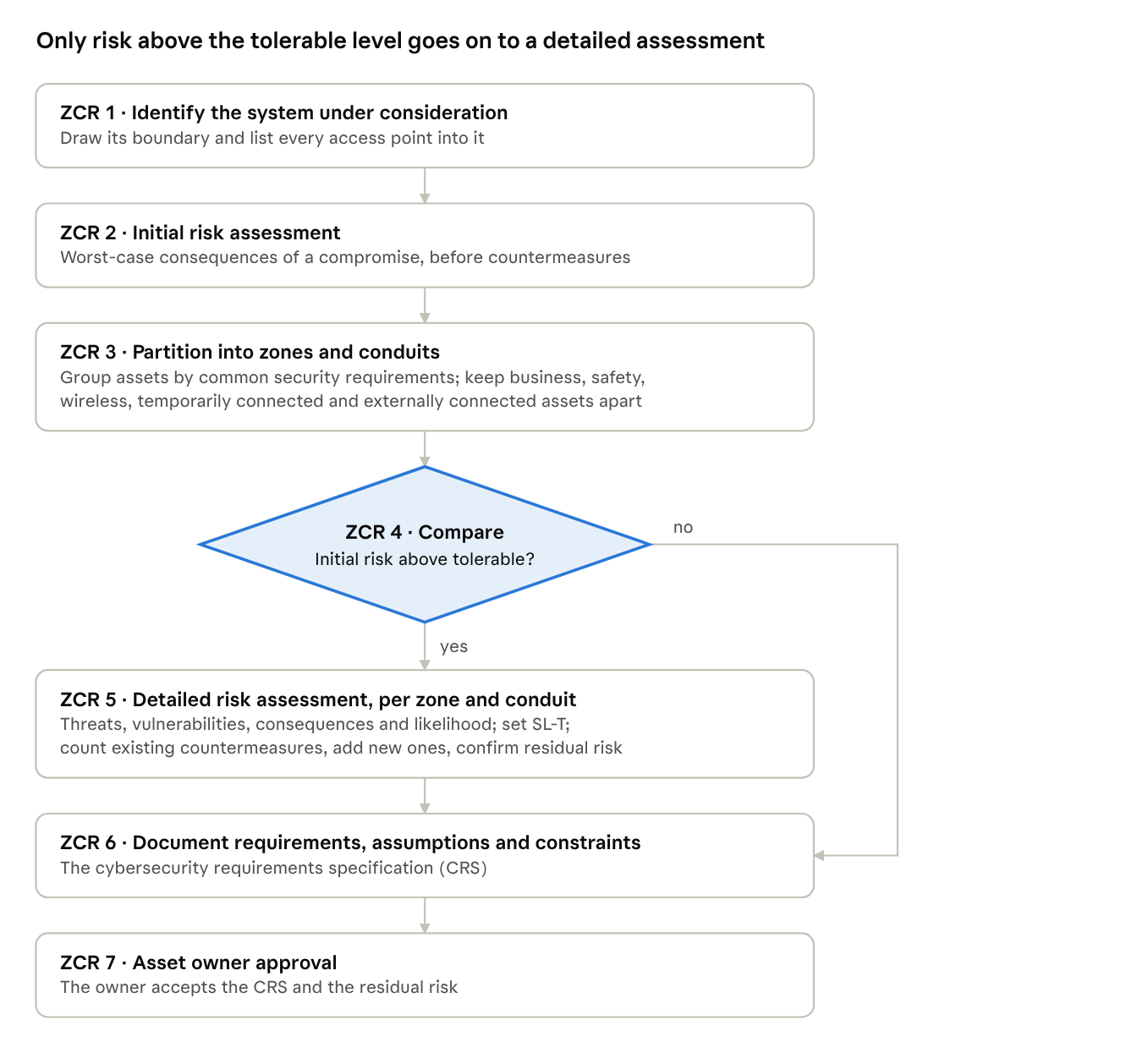
ZCR 1, identify the SUC. Set the boundary and list the access points. The SUC can be a whole site's IACS or one process unit, and it should include the supporting systems that can affect it, such as historians, engineering workstations and domain services.
ZCR 2, initial risk assessment. Ask what the worst credible outcome would be if the SUC, or a major part of it, were compromised, before counting any countermeasures. PHA results and business impact data feed this step. The answer shows how critical each part is and guides the partitioning.
ZCR 3, partition into zones and conduits. Its sub-requirements say what to keep apart:
| ZCR | Requirement | Why |
|---|---|---|
| 3.1 | Establish zones and conduits | Group assets by common security requirements |
| 3.2 | Separate business and IACS assets | Business systems face different threats and change faster |
| 3.3 | Separate safety-related assets | Protect the last automated layer of protection |
| 3.4 | Separate temporarily connected devices | Laptops and portable media come and go with unknown hygiene |
| 3.5 | Separate wireless devices | Radio extends the network beyond physical walls |
| 3.6 | Separate devices connected through external networks | Remote and cloud connections cross trust boundaries |
Partitioning tips. Every asset in a zone inherits the zone's target security level, so a zone that mixes critical and minor assets must either meet the highest need or be split. Group by criticality, function, location, ownership or technology. Too many tiny zones are hard to manage; one big zone lets a single compromise spread. Keep conduits few, with known and documented flows.
ZCR 4, compare initial risk with tolerable risk. Where the initial risk is above the tolerable level, carry out a detailed risk assessment of the zones and conduits (ZCR 5). Where it is not, go straight to documenting the requirements (ZCR 6).
Exam angle: know the order of the steps and the six ZCR 3 sub-requirements. Safety-related assets, wireless, temporary devices and external connections each get separated.
7 · Detailed risk assessment (ZCR 5)
The detailed assessment runs for each zone and conduit whose initial risk was above the tolerable level. It has thirteen steps:
| ZCR | Step | What you do |
|---|---|---|
| 5.1 | Identify threats | Threat sources, their capability, the vectors they could use and the assets affected |
| 5.2 | Identify vulnerabilities | Weaknesses in assets, architecture, configuration and procedures, drawn from the vulnerability assessment |
| 5.3 | Determine consequence and impact | What happens if each threat succeeds, rated on the company's consequence scale with PHA input |
| 5.4 | Determine unmitigated likelihood | How likely each threat is to succeed, ignoring existing countermeasures |
| 5.5 | Determine unmitigated cyber risk | Combine likelihood and consequence on the risk matrix |
| 5.6 | Determine SL-T | The target security level, per foundational requirement, that the zone or conduit needs |
| 5.7 | Compare unmitigated risk with tolerable risk | Decide where countermeasures are needed |
| 5.8 | Identify and evaluate existing countermeasures | What is already in place, and how well it actually works |
| 5.9 | Reevaluate likelihood and impact | Rate them again with the existing countermeasures counted |
| 5.10 | Determine residual risk | The risk that remains with existing countermeasures |
| 5.11 | Compare residual risk with tolerable risk | Is it acceptable now? |
| 5.12 | Identify additional countermeasures | Technical, procedural or physical measures until residual risk is tolerable |
| 5.13 | Document and communicate results | Record the results and report them to the people who need them |
Steps 5.9 to 5.12 form a loop: add countermeasures, re-rate, and compare again until residual risk is tolerable or the owner formally accepts what remains.
Setting SL-T (ZCR 5.6). The owner decides how risk maps to a target level, for example from the capability of the credible threat using the SL definitions, or from a table that maps unmitigated risk to a level. The result is a vector, so think about which foundational requirements matter for this zone: integrity and availability usually dominate in a control zone, while confidentiality may matter more for a server holding recipes or credentials.
Crediting existing countermeasures (ZCR 5.8). Credit only what works as installed. A firewall with "any to any" rules, antivirus with signatures a year old, or a procedure nobody follows reduces nothing. Verify by configuration review or observation rather than by asking.
Running the workshops
- Bring the cross-functional team together and walk the zones and conduits one at a time.
- Group similar scenarios so the list stays manageable.
- Record assumptions, such as "the business network is untrusted", as you go; they become part of the CRS.
- Capture every scenario, rating and decision in the risk register.
Exam angle: unmitigated likelihood and risk come before existing countermeasures are counted; SL-T is set inside ZCR 5 (5.6); residual risk is compared with tolerable risk, and countermeasures are added until it is tolerable.
8 · Process safety links: PHA, cyber PHA and the SIS
Risk assessors must be able to read process safety studies, because they hold the consequences that make IACS risk different.
| Term | Meaning |
|---|---|
| PHA | Process hazard analysis: a systematic review of a process's hazards and safeguards |
| HAZOP | The most common PHA method: guide words (no, more, less, reverse, other than) applied to parameters such as flow, pressure, temperature and level at each node reveal deviations, their causes, consequences and safeguards |
| LOPA | Layer of protection analysis: checks whether independent protection layers reduce the risk of a scenario enough, and sets SIL targets for safety instrumented functions |
| IPL | Independent protection layer, such as a SIS function, a relief valve or a dike |
| SIF and SIL | A safety instrumented function and its safety integrity level |
What a cyber assessment takes from the PHA
- Consequences: the worst credible outcome of each deviation, which feeds the initial assessment (ZCR 2) and consequence rating (ZCR 5.3).
- Causes and safeguards: which control and safety functions the PHA relies on. If one attack can both create the deviation through the control system and disable the programmable safeguard, the risk reduction the PHA assumed no longer holds.
- Safeguards an attack cannot reach: relief valves, mechanical overspeed trips and hardwired interlocks keep working whatever happens on the network. They bound the worst cyber consequence and are often the best answer when the consequence is severe.
Cyber PHA (also called a cyber HAZOP) adds a cyberattack as a cause. For each scenario where a programmable system is a cause or a safeguard, the team asks whether an attacker could produce the deviation and defeat the programmable safeguards at the same time. Where the answer is yes, it recommends safeguards an attack cannot reach, or stronger security countermeasures.
| PHA entry | Cyber question |
|---|---|
| High pressure if the control valve fails open; safeguards are a SIS high-pressure trip and a relief valve | Could an attacker drive the valve open through the control system and also bypass the trip? The relief valve still limits the outcome, so the worst case is a release to flare, not a rupture |
Securing the safety instrumented system
- IEC 61511-1 requires a security risk assessment of the SIS (clause 8.2.4) and a design resilient against the risks it finds (clause 11.2.12). ISA-TR84.00.09 explains how to fold cybersecurity into the safety lifecycle.
- Put the SIS in its own zone (62443-3-2 ZCR 3.3), restrict and monitor engineering access, keep controller key switches in run, and control bypasses.
- Integrated control and safety systems that share networks or workstations need especially careful zoning.
Exam angle: the PHA supplies consequences; safeguards an attack cannot reach limit the worst case; one attack defeating both cause and safeguard is the key cyber PHA question; the SIS gets its own zone.
9 · Countermeasures, SL-T and residual risk
Kinds of countermeasure
| By form | Examples |
|---|---|
| Technical | Firewalls, authentication, allowlisting, encryption, monitoring |
| Procedural | Policies, management of change, training, account reviews, backup procedures |
| Physical | Locked rooms and cabinets, port blockers, controller key switches |
They can also be described by effect: preventive (stop the attack), detective (notice it) and corrective (recover from it). A good set covers all three.
Weighing candidates. ISA's course objectives call for evaluating cost, complexity and effectiveness:
| Factor | Questions to ask |
|---|---|
| Effectiveness | Which scenarios does it address, and by how much does it cut likelihood or consequence? |
| Cost | Purchase plus the lifecycle cost: licenses, maintenance, staff time |
| Complexity | Skills needed to run it; operational burden; chance of misconfiguration |
| Operational impact | Latency, availability, safety, vendor support and warranty |
| Feasibility | Works with legacy equipment? Needs an outage? How long to implement? |
Prefer measures that cover many scenarios at once, such as segmentation; layer them for defense in depth; and never pick one that compromises an essential function.
A simple cost-benefit check. If a countermeasure lowers annualized loss expectancy from $100,000 to $20,000 and costs $30,000 a year to own, it returns $50,000 a year. Few cyber risks have reliable numbers, so most teams make the same comparison qualitatively.
From SL-T to design. The SL-T vector from ZCR 5.6 decides which 62443-3-3 system requirements and requirement enhancements apply to each zone and conduit. Components and system designs should have an SL-C that meets the SL-T for every foundational requirement. Where one falls short, add compensating countermeasures at the zone level, or document the gap as residual risk. The SL-A is verified after implementation.
Gaps in policies and procedures are countermeasures too. Missing account management, untested backups or no management of change often show up when practice is compared with 62443-2-1 or the owner's own policies. Their fixes are procedural and usually cheap.
Residual risk. Record the residual risk for each zone and conduit. If it is still above the tolerable level and no reasonable countermeasure exists, the options are to redesign (avoid the risk), transfer part of it, or accept it formally at the right level of management with a written justification.
Presenting recommendations. Rank them by risk reduction. Separate quick wins, such as changing default passwords or removing unused remote access, from longer projects such as re-architecting the network, and lay them out as a roadmap.
Exam angle: weigh effectiveness, cost and complexity; credit only countermeasures that actually work; SL-C must meet SL-T or be compensated; residual risk is accepted by the asset owner.
10 · The CRS, reports and approval (ZCR 6–7)
ZCR 6 requires the cybersecurity requirements, assumptions and constraints to be written down in a cybersecurity requirements specification (CRS). Its contents follow ZCR 6.1 to 6.9:
| ZCR | Content | What it holds |
|---|---|---|
| 6.1 | Cybersecurity requirements specification | The document itself, assembled from the items below |
| 6.2 | SUC description | Name, purpose, boundary and a high-level description of the system |
| 6.3 | Zone and conduit drawings | The partitioned architecture |
| 6.4 | Zone and conduit characteristics | For each zone and conduit, the attributes listed below |
| 6.5 | Operating environment assumptions | For example the physical setting, staffing and support arrangements |
| 6.6 | Threat environment | The threat sources and vectors that were considered |
| 6.7 | Organizational security policies | The owner's policies the design must follow |
| 6.8 | Tolerable risk | The owner's risk criteria |
| 6.9 | Regulatory requirements | Laws, regulations and standards that apply |
Zone and conduit characteristics (ZCR 6.4) include a name or identifier; the accountable organization; the logical boundary and, where relevant, the physical boundary; the safety designation; the logical and physical access points and the data flows through them; the connected zones and conduits; the assets with their classification, criticality and business value; the SL-T; the applicable security requirements and policies; and the assumptions and external dependencies.
Who uses the CRS. Integrators and suppliers design to it, procurement buys against it, factory and site acceptance tests verify against it, and maintenance keeps it current through management of change. It is the hand-off from the assessment phase to the design phase.
ZCR 7, asset owner approval. Management with the authority to do so reviews and signs off the CRS, the residual risk and the assumptions behind them.
The assessment report
| Section | Contents | Main reader |
|---|---|---|
| Executive summary | Overall posture, top risks, key recommendations | Management |
| Scope and method | Scope, team, dates, rules of engagement, standards used, limitations | Everyone |
| Findings | Vulnerabilities and gaps with evidence, mapped to requirements | Engineering and security |
| Risk register | Scenarios with unmitigated and residual ratings | Risk owners |
| Recommendations | Prioritized countermeasures with effort and cost, as a roadmap | Management and engineering |
| Appendices | Inventory, network and zone and conduit diagrams, raw data | Engineering |
The report is a map of the site's weaknesses: classify it as confidential, limit distribution and protect stored copies.
Documents to keep current after the assessment: the asset inventory, network and zone and conduit diagrams, the CRS, the risk register, and the policies and procedures. Management of change and periodic reassessment keep them accurate.
Exam angle: the CRS is the output of ZCR 6 and the input to design; it holds the SL-T of each zone and conduit, the assumptions, the threat environment, tolerable risk and regulations; the asset owner approves it in ZCR 7.
Exam traps, tie-breakers and sources
Pairs that get mixed up
| Easily confused | The difference |
|---|---|
| Initial and detailed risk assessment | ZCR 2: worst-case consequences for the whole SUC, before partitioning. ZCR 5: threats, vulnerabilities and likelihood per zone and conduit |
| Unmitigated and residual risk | Before existing countermeasures are counted; after they are counted |
| SL-T, SL-C, SL-A | Set in ZCR 5.6 for zones and conduits; offered by products; verified after implementation |
| Threat and vulnerability | Who or what could cause harm; the weakness they would use |
| Gap, vulnerability and risk assessment | Compare with a standard; find weaknesses; combine threat, weakness and consequence |
| Vulnerability scan and penetration test | Finds likely weaknesses; proves impact by exploiting them |
| CVSS score and risk | Technical severity of a flaw; what it means for your plant |
| CRS and assessment report | Requirements handed to design; findings and recommendations for the owner |
| ZCR 3.3, 3.4, 3.5, 3.6 | Separate safety-related assets; temporarily connected devices; wireless; external network connections |
First steps the exam likes to ask about
- Any 62443-3-2 assessment: identify the SUC, its boundary and access points (ZCR 1).
- Before any active test: agreed rules of engagement and operations' approval.
- Rating a scenario: unmitigated likelihood and risk first, then existing countermeasures.
- Rating consequence: start from the PHA.
Tie-breakers for BEST answers
- Passive methods before active ones on a running system.
- Credible scenarios over the worst imaginable one.
- The asset owner sets tolerable risk and accepts residual risk.
- Credit only countermeasures that are verified to work.
- Write assumptions down; they belong in the CRS.
- Choose the cross-functional answer over one person or one tool.
Sources
- ISA: IC33 course description, certificate program FAQ, certificate exams and testing
- Fraunhofer course page for IC33
- CISA CSET source and releases
- Vulnerability data: NVD, CISA KEV catalog, CVSS from FIRST
- MITRE ATT&CK for ICS
These notes paraphrase and summarize. They do not reproduce the standards, so check details against your licensed copies of 62443-3-2 and IEC 61511.